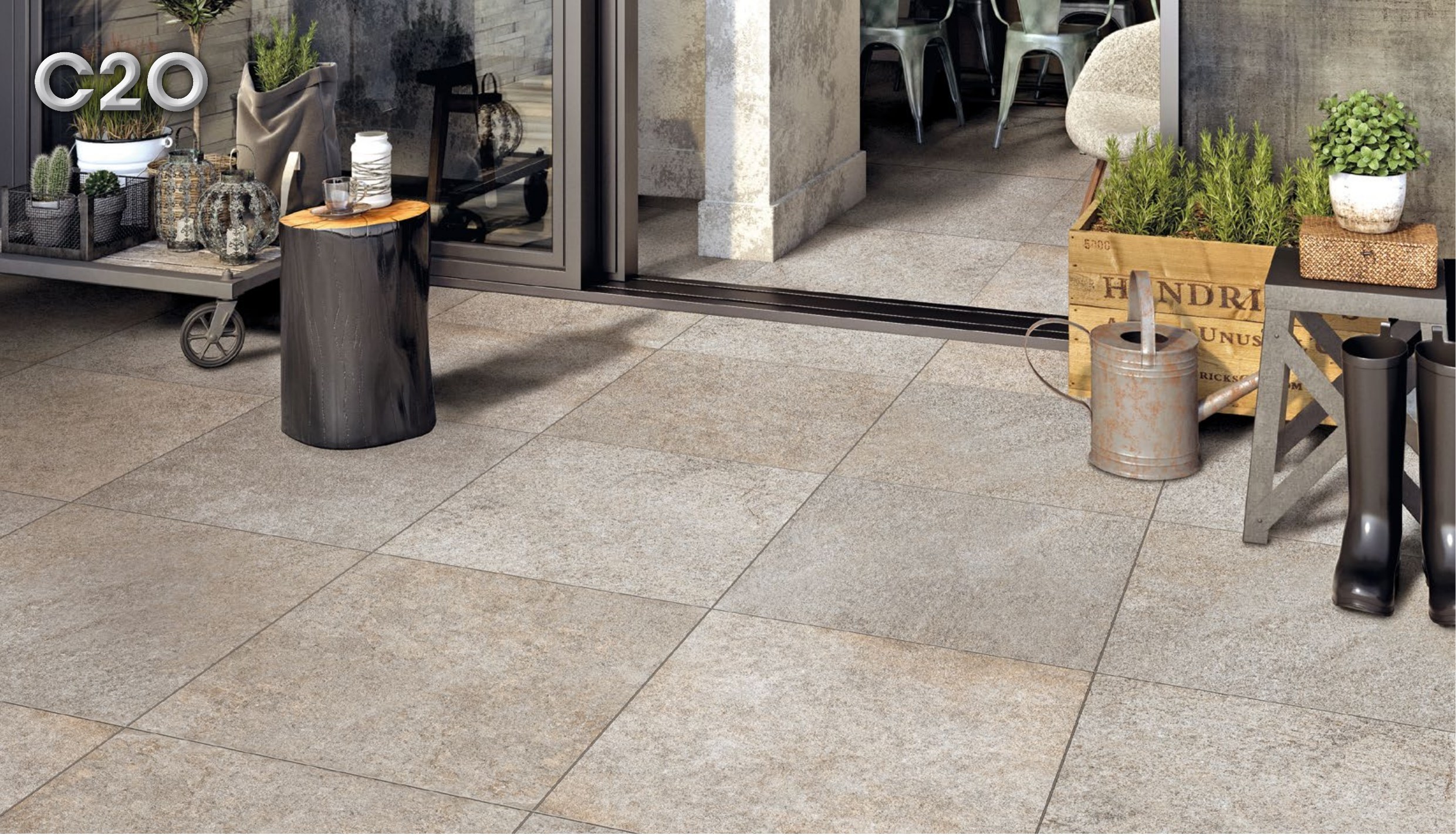
R9, R10 and R11 indicate the slip resistance of tiles according to the DIN 51130 standard: the higher the number, the more grip the surface has. What it means in practice: for dry interiors (bedroom, living room) R9 is enough, for bathrooms and kitchens R10 is better, and for outdoors, external stairs and pool edges you need R11.
That “R” code on the spec sheet isn’t some in-house shop code: it’s the result of a standardised laboratory test. Understanding it matters for two reasons. First: you avoid slipping, literally. Second: you avoid buying a tile rougher than you need, one you’ll then struggle to clean for the next twenty years.
Let’s look at what the R scale actually measures, which class you need in each room and which myths to leave behind.
R10 tiles: what the code means and what the standard measures
The classification comes from the German DIN 51130 standard. The test is almost theatrical: a technician wearing standard shoes climbs a ramp covered with the tiles to be tested and coated in oil. The ramp tilts little by little, until the technician starts to slip. The angle reached at that moment determines the class.
- R9: slipping between 6° and 10° of incline. Basic grip, for dry areas.
- R10: between 10° and 19°. The most widely used compromise: good grip, surface still easy to clean.
- R11: between 19° and 27°. Textured surface, designed for wet or outdoor areas.
- R12 and R13: beyond 27°. Technical and industrial settings; at home you almost never need them.
One curious point that clears up a common doubt: the scale starts at R9, not at R1. There are no R3 or R5 tiles. If a surface doesn’t even reach 6°, it simply isn’t classified.
Which class in which room: the practical table
You don’t need the same class everywhere. You need the right class for how you’ll use that surface. Here’s our reference table, room by room.
| Setting | Recommended class | Why |
|---|---|---|
| Bedroom, living room, hallway | R9 | Dry areas: basic grip is enough and cleaning stays effortless |
| Bathroom and kitchen | R10 | Water and grease reach the floor: one extra step of safety without giving up practicality |
| Flush walk-in shower | R10 + class B barefoot | Wet surface and bare feet: here the second scale matters too (we’ll cover it shortly) |
| Terrace, balcony, walkway | R11 | Rain, leaves, frost: outdoors the surface has to hold even when wet |
| Pool edge, external stairs | R11 + class B/C barefoot | The most critical combination: constant water and bare feet |
For outdoors there’s also the thickness question: garden and terrace surfaces are generally made in 20 mm, like the C2O versions of many series in our catalogue. We cover it in detail in the guide to 20 mm porcelain stoneware for outdoors and how to lay it.
The myth: “I’ll get R11 everywhere and I’m sorted”
It sounds logical: more grip, more safety, so R11 throughout the house. In practice it’s a choice you’ll quickly regret, for three reasons.
- Cleaning. Grip comes from the structure of the surface: micro-reliefs that slow the sole down. Those same reliefs trap dirt, limescale and grease. In the kitchen, a textured R11 gets cleaned with a scrubbing brush and elbow grease, not with a quick wipe of a cloth.
- Comfort. On a heavily textured surface bare feet feel the roughness, chairs slide less smoothly, socks wear out sooner. In the living room that’s not what you want.
- Pointless cost. You’re paying for a technical performance you’ll never use in the bedroom.
The opposite is true too, and it’s the more dangerous mistake: a smooth, elegant R9 on the terrace. When dry it’s perfectly fine, but at the first rain it turns into a slide. The rule is just one: the class is chosen room by room, based on water and real use.
Bare feet and wet: the A, B, C scale
The R scale measures slipping with shoes on. But in the shower and at the pool you walk barefoot, and a bare foot on a wet surface behaves differently from a sole. That’s why there’s a second test, DIN 51097: you walk barefoot on a ramp wetted with water and soap, and here too the angle reached is what counts.
- Class A: basic barefoot grip. Changing rooms and mostly dry areas.
- Class B: showers, walk-in shower trays, pool edges.
- Class C: the maximum. Submerged steps, sloped surfaces that are always wet.
The practical tip: if you’re building a flush walk-in shower or tiling the edge of a pool, don’t stop at the R rating. Look on the spec sheet for the barefoot class too and aim for at least a B.
Watch out for one detail: the two scales don’t convert into each other. An R10 tile isn’t automatically class B, because the tests are different (shoes and oil on one side, bare feet and soapy water on the other). If the barefoot figure doesn’t appear on the spec sheet, it means that product hasn’t been tested for that use: for a walk-in shower choose a surface that states it, or ask us to confirm before you order.
Where to find the figure in our spec sheets and how to filter the catalogue
On every Gresio product page the “slip resistance” entry shows the surface’s R class, along with the other technical figures that matter: water absorption, shade variation, rectified edge or not. If that last term is new to you, we’ve also explained the difference between rectified and non-rectified tiles.
Two tools save you time and mistakes:
- The anti-slip class filter: in the catalogue you can filter products by slip resistance and see only the series suited to your setting. Start from the filter, then choose the look: that’s the right order.
- The €5 sample, refunded on your order: you only really understand grip by touching the surface. Reading “R11” is one thing; running your hand over it and feeling the texture is another. We explain it all on the page about how samples work.
One last honest note: the R class is a laboratory test, not an absolute guarantee. An R11 floor covered in wet leaves is still treacherous. The classification tells you which surface starts with an advantage; after that, laying, cleaning and common sense are what count.
In short: choose the right grip, not the highest
R9 where you live dry, R10 where household water reaches, R11 where it really rains, with an eye on the A/B/C class where you walk barefoot. That’s all there is to it. The rest is choosing a surface you’ll enjoy looking at every day.
Once you’re clear on the setting, open the catalogue and filter by anti-slip class: in a few clicks you’ll see only the suitable series. And before ordering the square metres, have a sample sent to you: €5, refunded with your order, and no surprises underfoot.