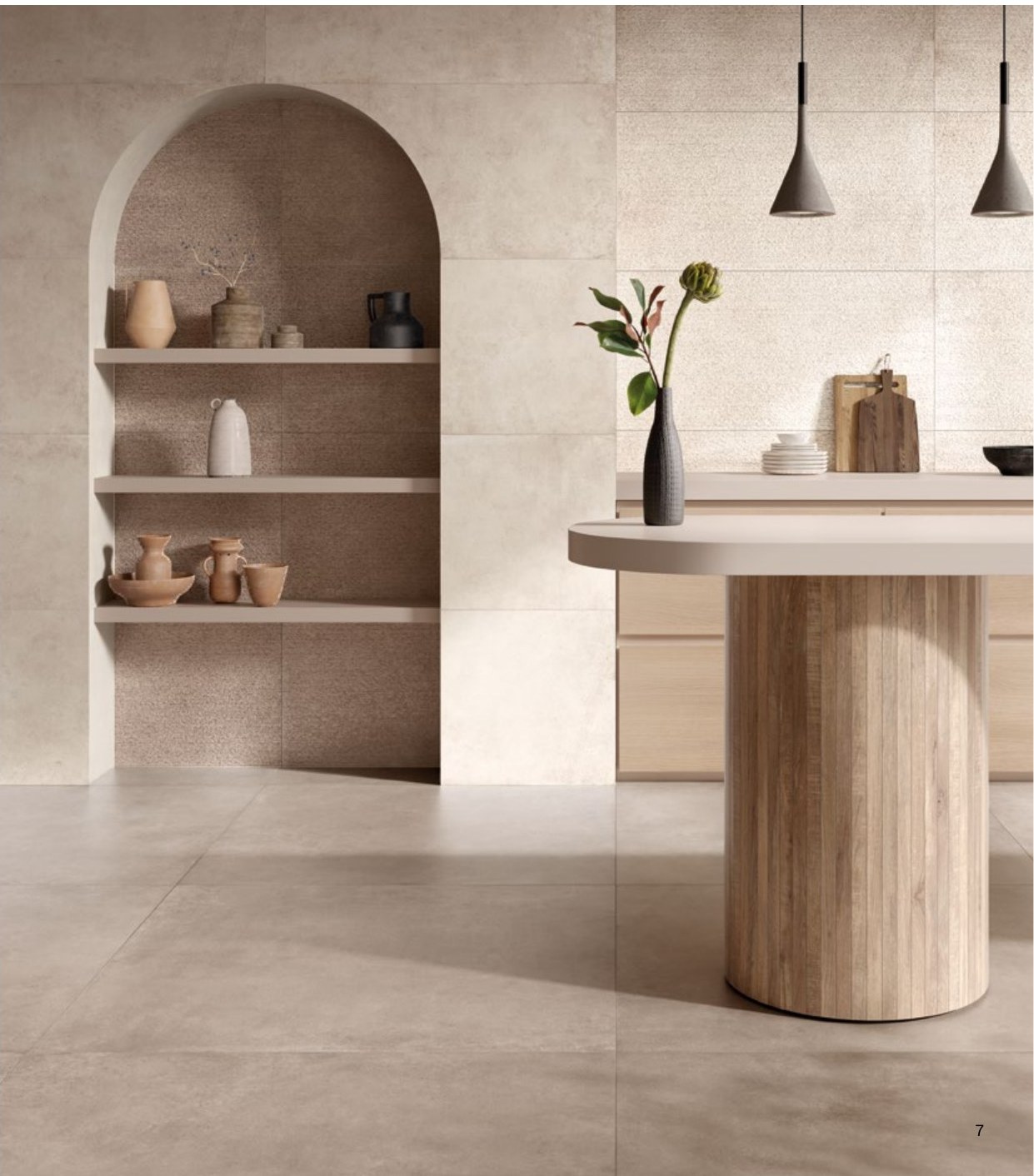
You calculate tiles per m2 like this: measure the square metres of the room, add 10% wastage (15% if you’re laying diagonally or in a herringbone pattern) and round up to the whole box. Order everything at once: the leftover boxes aren’t waste, they’re your insurance.
How many tiles do you need for a 12 m2 bathroom? Not 12 m2. It’s the most common mistake made by people buying tiles online, and also the most expensive: you end up with the job underway and no material, the tiler idle and the risk that the boxes ordered later won’t be identical to the first ones. In this guide we look at the exact formula, an example with real numbers and a few tips that make the difference at the end of the job.
Why wastage isn’t an extra but part of the job
Wastage is the share of tiles you buy already knowing they won’t end up whole on the floor. It’s not over-caution: it’s the arithmetic of the building site.
- Unavoidable cuts. Walls are never exact multiples of the format: along the edges, in the corners, around doors, drains and columns every tile has to be cut. The offcut often can’t be reused.
- Breakages. A few pieces may break during handling or cutting. It happens even to the best tilers.
- Future replacements. In five years a chipped tile can only be replaced if you’ve kept aside pieces from the same batch. Buying it again afterwards, in the exact same shade, is almost impossible.
People who order “just enough” to save a box almost always end up placing a second order. And a second order means waiting for another delivery and paying for another shipment: the box you “saved” becomes the most expensive of all.
Calculating tiles per m2: the formula in three steps
The formula is simple and works for floors and wall coverings:
- Measure the surface. Length x width of the room, in metres. If the layout is irregular, divide it into rectangles and add them up. Don’t subtract the furniture: the floor runs under the kitchen and the shower too.
- Add the wastage. Multiply by 1.10 if you’re laying straight (or offset), by 1.15 if you’re laying diagonally or in herringbone.
- Round up to the box. Divide the result by the m2 contained in one box (you’ll find it on every product data sheet) and always round up. Tiles are sold in whole boxes, not single pieces.
Let’s see it with real numbers. A 12 m2 bathroom, straight laying, wood-effect planks with 1.49 m2 boxes (like many planks in our Woodland series):
- 12 m2 x 1.10 = 13.2 m2 of material needed
- 13.2 / 1.49 = 8.86 boxes -> round up to 9 boxes
- 9 x 1.49 = 13.41 m2 ordered
Same bathroom but with diagonal laying: 12 x 1.15 = 13.8 m2; 13.8 / 1.49 = 9.26 -> you need 10 boxes, that is 14.9 m2. One extra box just for turning the layout by 45 degrees: that’s why the type of installation should be decided before ordering.
How much wastage do you need? It depends on how you lay
10% is the basic rule, but not all layouts consume the same way. Here are the values to use in the calculation:
| Type of installation | Recommended wastage | Why |
|---|---|---|
| Straight or offset | 10% | Cuts only along the perimeter: it’s the most efficient layout |
| Diagonal (45) | 15% | Every tile at the edge of the room is cut on the slant and the offcut doubles |
| Herringbone | 15% | Slanted cuts all round the perimeter, like the diagonal |
| Irregular rooms, many doors and niches | 12-15% even if straight | More edges = more cuts, regardless of the pattern |
If herringbone tempts you, in the guide to herringbone porcelain installation you’ll also find which plank formats really work. In any case: agree the layout with the tiler before ordering, not after.
Why order everything at once (the story of the shade)
There’s a technical reason, beyond the logistical one, why the calculation has to be done well first time: tiles are produced in batches, and each batch has its own shade and its own calibre.
Two boxes of the same tile but from different batches can have a slightly different shade of colour and an actual size that varies by a few tenths of a millimetre. On a laid floor, that difference shows: a “patch” of lighter tiles or joints that don’t line up.
By ordering everything together, the material leaves our warehouse in the same batch: uniform shade and calibre across the whole surface. If instead you top up months later, the batch will almost certainly be a different one. For the same reason the sample you receive at home tells you colour and surface, but the exact shade of your consignment may vary slightly: we explain this well in the guide to how samples work.
There’s an economic advantage too: tiles travel on a pallet, and a single order means just one pallet delivery instead of two. Two small orders almost always cost more than one right one.
The m2 <-> boxes calculator: let the product page do the maths
Everything you’ve read so far is done by an automatic calculator on our product pages. You enter the square metres of the room, indicate whether the laying is straight or diagonal, and the system:
- adds the correct wastage (10% or 15%);
- rounds up to the whole box;
- shows you how many boxes go in the cart and how many actual m2 you’re ordering.
It also works in reverse: if you already have a number of boxes in mind, you immediately see how many square metres they cover. You’ll find it on every product in the catalogue, under the price. No calculator, no rounding errors.
Leftover boxes aren’t money thrown away
When the job is done you’ll have some whole tiles left over. That’s good: it’s the correct result of the calculation, not a mistake. What to do with them:
- Keep at least one box aside, flat and in a dry place, with the batch label clearly visible. It’s your spare for the next twenty years: a tile chipped by a dropped pan is replaced in an hour if you have the right piece.
- Ask the tiler to leave you the good half-pieces too: useful for small repairs near the edges.
- Note the name of the series and the batch on the house records too (or in a photo on your phone): years from now you won’t remember the code.
The logic counts double in case of unexpected delivery issues: if a piece arrives damaged, the wastage lets you start the work anyway while we handle the replacement.
In short: measure, add, round up
Square metres of the room, plus 10% (15% for diagonal or herringbone), rounded up to the whole box, all in a single order. It’s a two-minute calculation that saves you idle building sites, mismatched shades and double shipments.
If you want to start off on the right foot: choose the tile in our catalogue, order a sample for 5 (refunded as a voucher on your first order) and once you’re convinced let the on-page calculator do the maths. We’ll take care of the rest, from the warehouse to your home.