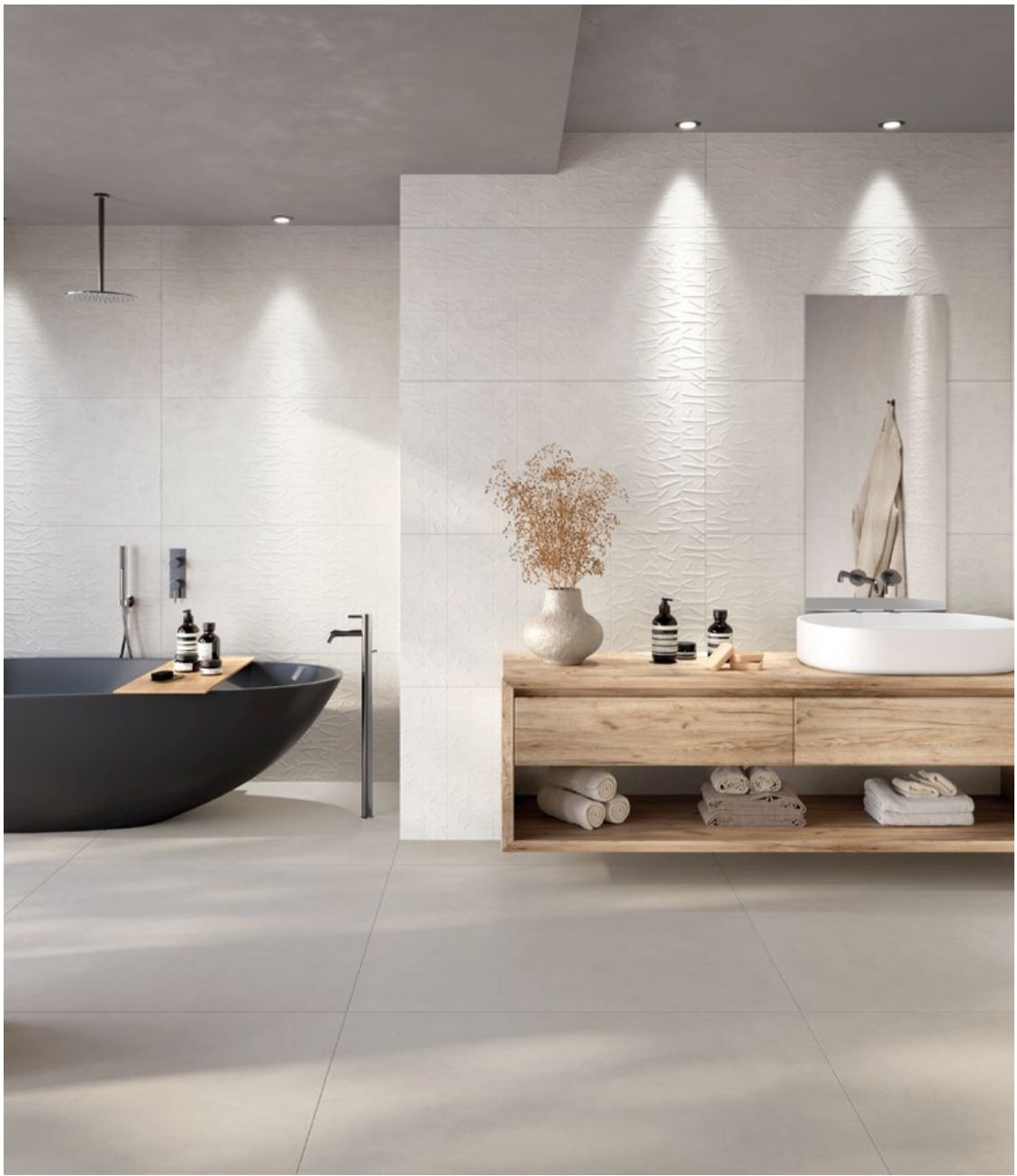
Concrete-effect porcelain gives you the industrial look of polished concrete or resin without opening a building site: no screed to pour, no cracks, no periodic treatments. It’s laid like an ordinary tile and cleaned with water and a neutral detergent. The only truly tricky choice is the right shade of grey for your home.
The industrial style is popular because it’s clean, textured and never goes out of fashion. The paradox is that the two materials that made it famous, polished concrete and resin, are also the most delicate to install and maintain. Concrete-effect porcelain stoneware was created to solve this problem: same face, far fewer worries.
In this guide we compare the three materials without cutting corners, then help you choose the right grey and introduce the concrete-effect series in our catalogue.
Real concrete, resin or concrete-effect porcelain: an honest comparison
Let’s start with real concrete, meaning polished screed or microcement. It’s the original and has a genuine charm. But it’s a full-blown building site: demolition or overlays, curing times, dust throughout the house. And above all it has a structural flaw: cracks. A continuous concrete floor will crack sooner or later, it’s inevitable. Anyone who chooses it needs to know and accept this, perhaps as part of the charm.
Resin promises a continuous, grout-free surface. That’s true, but on three conditions: a perfect substrate, a very skilled applicator and careful maintenance. Resin scratches, it’s sensitive to certain aggressive detergents, and some formulations tend to yellow in direct sunlight. And if it gets damaged, repairing it invisibly is hard: often a whole area has to be redone.
Concrete-effect porcelain is a porcelain stoneware tile with the look and texture of concrete. It doesn’t crack, it doesn’t scratch with normal household use, and it doesn’t fear stains: porcelain stoneware absorbs very little water (the ISO 10545-3 standard classifies it below 0.5% absorption). In many cases it can be laid over the existing floor, with no demolition. The only aesthetic compromise is the grout lines, which with large formats shrink to a few millimetres and in grey tones almost disappear.
| Solution | Building work | Crack risk | Maintenance | Performance over time |
|---|---|---|---|---|
| Polished concrete / microcement | Long, with curing times | High: cracking is inevitable | Protective treatments to repeat | Marks and ages (a plus for some) |
| Resin | Medium: needs a perfect substrate | Medium: follows substrate cracks | Sensitive to scratches and harsh detergents | Some formulations yellow or go dull |
| Concrete-effect porcelain | Standard installation, often over the existing floor | Practically none | Water and neutral detergent | Stable: doesn’t yellow or mark |
In practical terms: if you love the industrial look but want no risks or upkeep, porcelain is the rational choice. If you want a continuous surface without a single grout line and accept the care it demands, resin remains an option. Real concrete makes sense in projects where cracks and the marks of time are part of the intended look.
Choosing the right grey: warm or cool?
“Grey” on its own means nothing. There are warm greys, which lean towards beige and sand (taupe, greige), and cool greys, which lean towards blue and lead (ash, anthracite). Getting the temperature wrong is the most common mistake: a cool grey in a dark, north-facing room turns gloomy, while a warm grey next to a black and steel kitchen can look dirty.
A few practical rules we use ourselves when advising clients:
- Natural wood furniture, leather, warm fabrics: choose a warm grey, like greige or taupe.
- White or black kitchens, steel, glass, clean lines: go for a cool grey.
- Small room or one with little natural light: stick to light tones, avoid anthracite.
- Large, bright space: you can be bold with dark tones, even wall to wall.
Then there’s a detail that makes the difference between a believable floor and a “fake concrete”: shade variation. Well-made concrete-effect series have V2 or V3 shade variation, meaning deliberate differences in tone and graphics from tile to tile, just as a real concrete pour is never uniform. If the term is new to you, we explain it well in our guide to shade variation from V1 to V4.
The single most useful piece of advice, though, is this: don’t choose a grey from a screen. Order a sample; on our site it costs €5 and is refunded on your first order. You lay it in your own home, with your light and your furniture, and in five minutes you know whether the tone is right. No photo replaces this test.
Total look: floor and wall in the same effect
Concrete-effect porcelain is at its best when it doesn’t stop at the floor. Taking the same series onto the shower wall, behind the hob or onto a living-room wall creates that material continuity that with real concrete would cost a second building site. In bathrooms it works beautifully: a compact, easy-to-clean surface, with no wallpaper or paint that fears humidity.
Two tips to avoid turning your home into a bunker. First: warm the whole up with living materials, wood, fabrics, plants, warm lighting. Successful industrial is always a contrast between the grey and something warm. Second: vary the formats. A large slab on the floor and a smaller format on the wall, or vice versa, give rhythm without breaking the palette.
And if you fear the monolithic effect, there’s a third route: some concrete- and resin-effect series also come in a plank format, which you can lay in a herringbone like parquet. The result is a softer, less predictable industrial. How it’s done, how much waste you need and what to ask the setter is in our guide to herringbone installation.
The concrete-effect series in our catalogue
In our catalogue the concrete effect is covered by three series, each with a different character:
- Caementum: the concrete most faithful to the original, textured and dry. It’s the choice for true industrial, lofts included.
- Le Resine: a soft, uniform surface that echoes the look of resin. Perfect if you want visual continuity with minimal texture.
- Grey Soul: the most versatile grey, works well with both modern furnishings and classic pieces. If you’re undecided, start here.
You’ll find them all in the concrete-effect porcelain category, with full technical sheets: formats, thicknesses, slip resistance and shade variation for each series. On every product there’s also the calculator that converts square metres into boxes, waste included: 10% for a straight layout, 15% if you choose a diagonal or herringbone.
Industrial without the building site: where to begin
To recap: concrete-effect porcelain gives you the look of concrete and resin with the easy life of a tile. No cracks, no treatments, quick installation and often no demolition. The real decision is the shade of grey, and that isn’t one you make in front of a screen.
The most sensible path is simple: look at the series in the concrete-effect category, choose two or three tones that convince you and order the €5 samples, refunded on your first order. Compare them in your home, in the morning light and the evening light. At that point the right grey chooses itself.