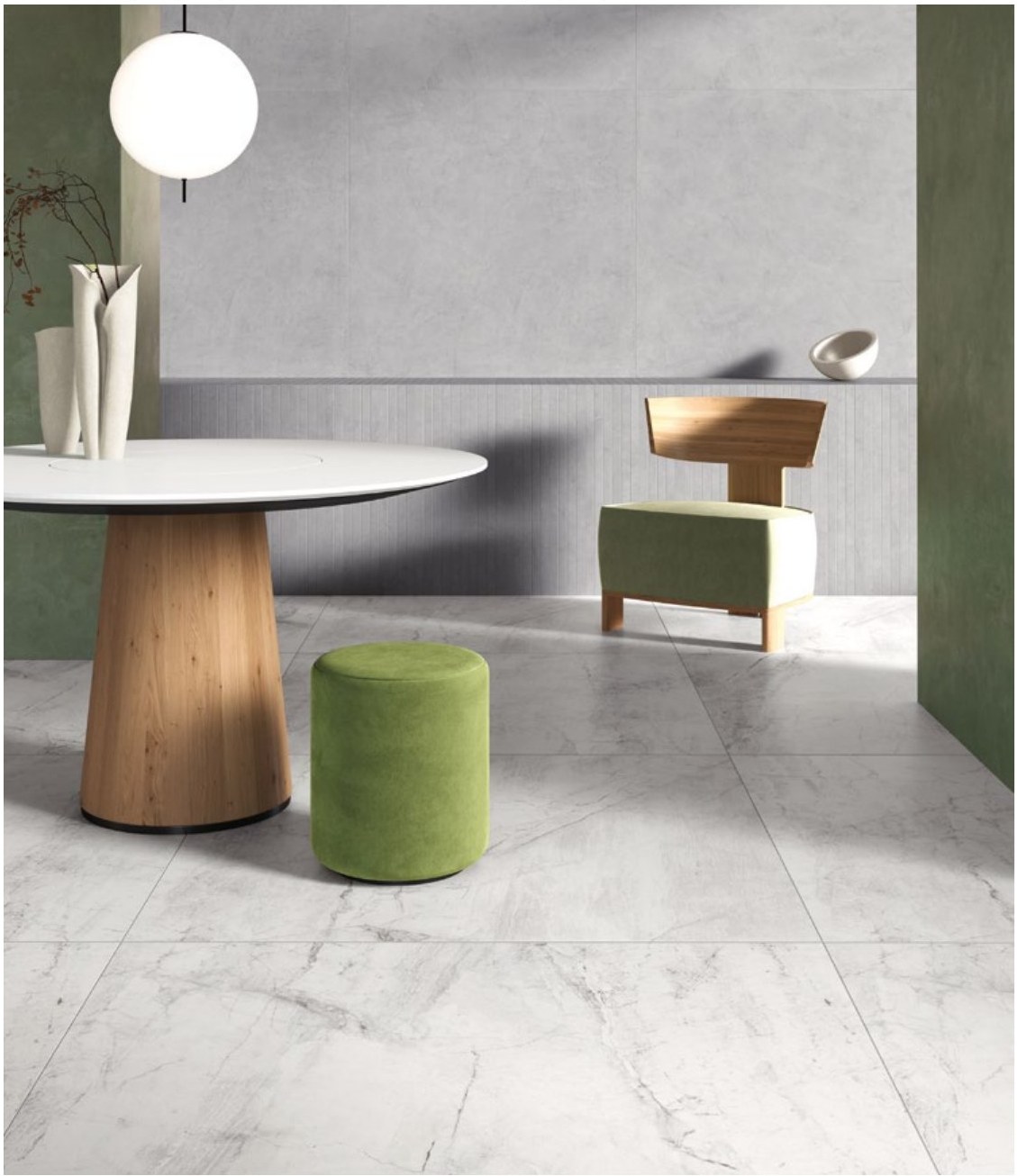
The difference between rectified and non-rectified tiles is all in the edge. On a rectified tile the edge is cut straight after firing: every piece is exactly the same size and they’re laid with 2 mm grout lines, for an almost seamless surface effect. In return you need a precise tiler and a level substrate: if those are missing, a natural edge with a 3-5 mm grout line is the better choice.
What “rectified” means: the edge cut straight after firing
When a tile comes out of the kiln it’s never identical to the others down to the millimetre. Firing above 1200 °C makes the material shrink, and the shrinkage varies slightly from piece to piece. That’s why a “natural” tile has slightly soft, barely rounded edges and small size tolerances.
Rectification eliminates the problem at the root: after firing, all four sides are cut and ground down until you get a clean 90-degree edge and the same size for every piece.
The practical result: tiles that fit together almost perfectly, without the eye picking up where one ends and the next begins.
Rectified and non-rectified tiles: the difference shows in the grout line
It all revolves around the grout line, that is, the space filled with grout between one tile and the next. With a natural edge you need a grout line of 3 to 5 mm: that space absorbs the small size differences between pieces. With a rectified tile 2 mm is enough, because those size differences are gone.
Watch out for one thing: a minimal grout line doesn’t mean a zero grout line. The grout line isn’t only there to make up for tolerances, it does more:
- it absorbs the floor’s expansion with temperature changes;
- it releases the small stresses in the structure, preventing chipping on the edges;
- it lets the grout adhere properly and stay stable over time.
That’s why, even with rectified tiles, the recommended grout line doesn’t go below 2 mm. Anyone who promises a “zero-joint” installation is promising you a problem a few years down the line.
2 mm or 3-5 mm grout line: the honest comparison
Here’s what really changes between the two options, point by point.
| Aspect | Rectified (2 mm grout line) | Non-rectified (3-5 mm grout line) |
|---|---|---|
| Visual effect | Almost seamless surface, very clean | Clearly visible grid of grout lines |
| Precision required from the tiler | High: mistakes show up immediately | Medium: the wide grout line is forgiving |
| Substrate | Must be perfectly level | Tolerates small irregularities |
| Installation cost | Higher (more time and care) | Standard |
| Grout maintenance | Less grout exposed, easier to clean | More grout exposed to dirt |
| Style | Modern, minimal, large formats | Rustic, classic, small formats |
The highlighted row is the reason rectified tiles are so popular: the aesthetic effect. But the rows below it are the price you pay to get it.
When rectified is worth it (and when it’s better to skip it)
Rectified tiles are at their best in these cases:
- Large formats. On slabs of 60×120 or 120×120 the thin grout line multiplies the “single surface” effect. We talk about it in the guide on large formats in small spaces too: fewer grout lines, a more airy room.
- Marble and concrete effect. A marble like our Athena series or a concrete like Grey Soul look their best when the graphics flow from one piece to the next without interruption. You’ll find both among the marble-effect tiles and the contemporary greys in the catalogue.
- Exposed wall coverings. On a bathroom wall or behind the kitchen, with raking light, the straight edge is the difference between an ordinary job and a magazine-worthy one. It also holds for corners: two rectified edges meeting form a clean corner, with no need for trims to cover it.
There’s one requirement that applies to all three cases: straight, plumb walls. Rectified tiles don’t create perfect walls, they demand them. If the wall “bellies out”, the thin grout line will tell the story to anyone who walks into the room.
When a natural edge is the better choice instead:
- Uneven substrate. If the screed has dips and you don’t want to redo it, the 2 mm grout line will highlight every flaw. The wide grout line hides them.
- Limited installation budget. Rectified tiles cost a bit more as a material, but above all they require more working hours from the tiler. If the installation quote is already tight, that’s where you risk cutting the wrong kind of quality.
- Rustic or textured style. In a farmhouse, in a taverna, with small formats like 20×20, the wide grout line is part of the language. Rectifying wouldn’t make sense.
Rectified doesn’t mean calibrated (or “first grade” either)
Let’s clear up two words that often get confused. The calibre is the actual size class of a batch: after firing, pieces are measured and grouped by uniform dimensions. It applies to all tiles, rectified or not. Rectified tiles take the concept to the extreme: the size is unique by definition, because the cut is mechanical.
Rectified says nothing about the quality of the surface or its resistance either: it only says how the edge is made. And it has nothing to do with the variability of the graphics from one piece to the next, which is shade variation: if you find codes like V2 or V3 on the data sheet, we explain what they mean in the guide to V1-V4 shade variation.
One last practical detail: rectified or not, always order all the boxes at once, from the same batch. That way tone and calibre are uniform and you don’t end up with visible differences halfway across the room.
Where to find the figure in our data sheets
In every product data sheet in our catalogue the “Rectified” field states a yes or a no, with no ambiguity, next to format, thickness and slip class. You don’t have to interpret photos or descriptions: the figure is written down. If a figure is missing, ask us before ordering, not after.
On the same page you’ll find the m²⇔boxes calculator: enter the square metres of the room and it tells you how many boxes to order, already including the wastage (10% for straight installation, 15% for diagonal or herringbone). With rectified tiles it pays not to skimp on wastage: spare pieces from the same batch are worth their weight in gold.
Before you decide, feel the edge with your own hands
The difference between a rectified edge and a natural one becomes clear in three seconds once you have the pieces in your hands, far less by looking at photos. That’s why the advice is always the same: order a sample, it costs €5 and we refund it on your first order. We explain how it works on the page dedicated to tile samples.
Then have a chat with your tiler: tell them you want a 2 mm grout line and watch how they react. If they say “no problem” with confidence, you’re in good hands. In the meantime you can browse the full catalogue and filter the rectified series: the goods leave our warehouse packed on pallets, designed to arrive intact.