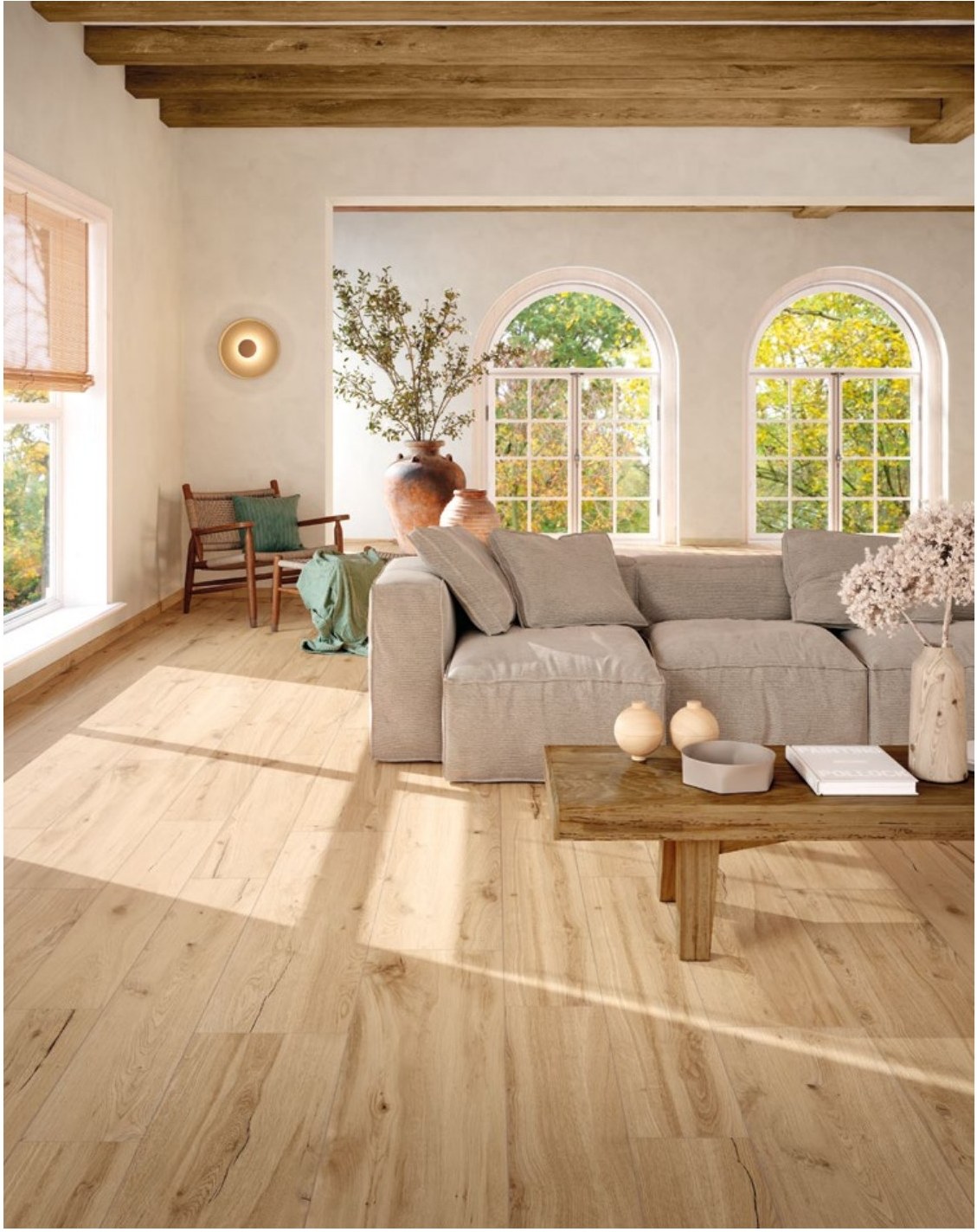
Shade variation indicates how much the graphics and tone change from one tile to another in the same series. The scale runs from V1 (virtually identical pieces) to V4 (every piece different from all the others). It isn’t a production defect: it’s a design choice, and it’s exactly what makes wood, stone and concrete effects believable.
What the V you find on the data sheet means
Open the data sheet of a wood-effect porcelain and you’ll find a code like “V3”. Nobody explains it to you, and yet it’s one of the figures that most changes the final result on your floor.
The point to nail down right away: a high V doesn’t mean tiles that “came out wrong”. The different graphics are printed on purpose, one by one, to imitate a natural material. In nature no two oak boards are alike, and neither are two slabs of stone. Porcelain that wants to look real has to do the same.
The opposite is also true: if you’re after a uniform, restful surface, for example a solid colour to match already busy furnishings, you need a low V. Neither is “better”: it depends on the effect you want at home.
Shade variation V1-V4: the scale level by level
The scale has four steps. Here they are one by one, from the most uniform to the most varied.
| Code | Variation between pieces | Typical effect | What to expect on the floor |
|---|---|---|---|
| V1 — uniform | Almost none: virtually identical pieces | Solid colours, technical surfaces | Homogeneous surface, no surprises from one piece to the next |
| V2 — slight | Small differences in tone and graphics | Soft concretes, delicate marbles | Barely perceptible movement, a very orderly whole |
| V3 — moderate | Clear differences but within the same colour range | Woods, stones, textured concretes | A lively, natural floor: it’s the most common level in material effects |
| V4 — strong | Every piece is different, even in the background colour | Rustic woods, mixed stones, majolica | A dramatic result, no piece repeats |
We highlighted V3 because it’s the one you’ll come across most often: most wood- and stone-effect porcelain lives there, at the balance point between naturalness and control.
Why “real” wood is almost always V3 or V4
Think of an authentic parquet floor: knots, veins, lighter and darker boards. If a wood-effect porcelain were V1, you’d see the same board repeated dozens of times, and the eye catches on immediately. It’s the classic “fake wood” floor you can spot from three metres away.
That’s why the wood-effect series in our catalogue, like Woodland and North Wind, work on many different graphics: boards with pronounced knots next to almost smooth boards, tones that shift within the same range. Once laid on the floor, the whole recreates the randomness of real wood. If you’re considering a wood effect for the bathroom, we’ve explained why wood-effect porcelain beats parquet in the bathroom precisely thanks to this combination of looks and water resistance.
The same reasoning applies to stone: a series like Dolomia Stone is convincing because the pieces aren’t photocopies of one another. Shade variation is the engine of credibility.
How to lay heavily shade-varied tiles
With V3 and V4 the result also depends on how the tiler works. The golden rule is one: mix. Here’s the correct sequence.
- Open 4-5 boxes together, never one at a time. Each box contains a mix of graphics, but by drawing from several boxes the mix becomes truly random.
- Take the pieces alternating between boxes, without choosing. If the tiler “selects” the graphics they like, they risk concentrating similar pieces in one area.
- Do a dry test layout over 2-3 m²: lay the pieces down without adhesive and look at them from a distance, in the room’s real light.
- Step back every few metres during installation: clusters of dark or heavily veined pieces show from a distance, not with your nose on the tile.
- Set aside the most characterful pieces (the darkest, the knottiest) and spread them out: they’re the seasoning of the floor, they shouldn’t all go in the same corner.
There’s also a practical consequence for ordering: with high V values it pays to buy all the material at once, with the right margin for cuts and spares. How to calculate it is in the guide to calculating tiles, boxes and wastage: 10% extra for straight installation, 15% for diagonal and herringbone.
Sample and batch: what can change and what can’t
Here shade variation plays a trick it’s best to know about beforehand. The sample you receive at home is one piece of a series that, by design, contains dozens of different graphics. With a V3 or V4, the tile that arrives in your order won’t be identical to the sample: it’ll be one of its “sisters”.
What the sample tells you anyway, and it’s worth every euro:
- the real colour range, seen in your home’s light (monitors lie);
- the surface to the touch: smooth, textured, structured;
- the look with your furnishings, the wood of your furniture, the colour of your walls.
What it can’t tell you: the exact graphic of every piece in the batch, precisely because of shade variation, and the precise tone of the production batch. That’s why on every one of our product pages you’ll find the sample at €5, refunded as a voucher on your first order: the full explanation is in the guide to tile samples at home in 24-48 hours.
Where to find the figure in our data sheets
In every product data sheet in our catalogue the shade variation is stated in the technical data section, next to format, thickness and slip resistance. No codes hidden in PDFs: the V value is written in plain view, with the explanation a click away.
Use it like this, in practice:
- want a uniform, quiet floor? Look for V1-V2;
- want a natural, believable material effect? V3 is the typical choice;
- want character and all-different pieces? Go for V4, and remember the rule of mixed boxes.
The room-set photos on our pages always show several pieces laid together, precisely to let you see the effect of shade variation on the floor, not the single perfect piece in a photo studio.
In short: read the V before you choose
Shade variation V1-V4 tells you in a single code how varied your floor will be. A low V for uniformity, a high V for naturalness; no defect, just a style choice to make knowingly, with a mixed installation when needed.
The best way to understand it is to see it in person: browse the wood-effect porcelain category, where shade variation is at its best, and order a sample of the series that win you over. Five euros, refunded on your first order: the risk of getting the floor wrong is worth far more.