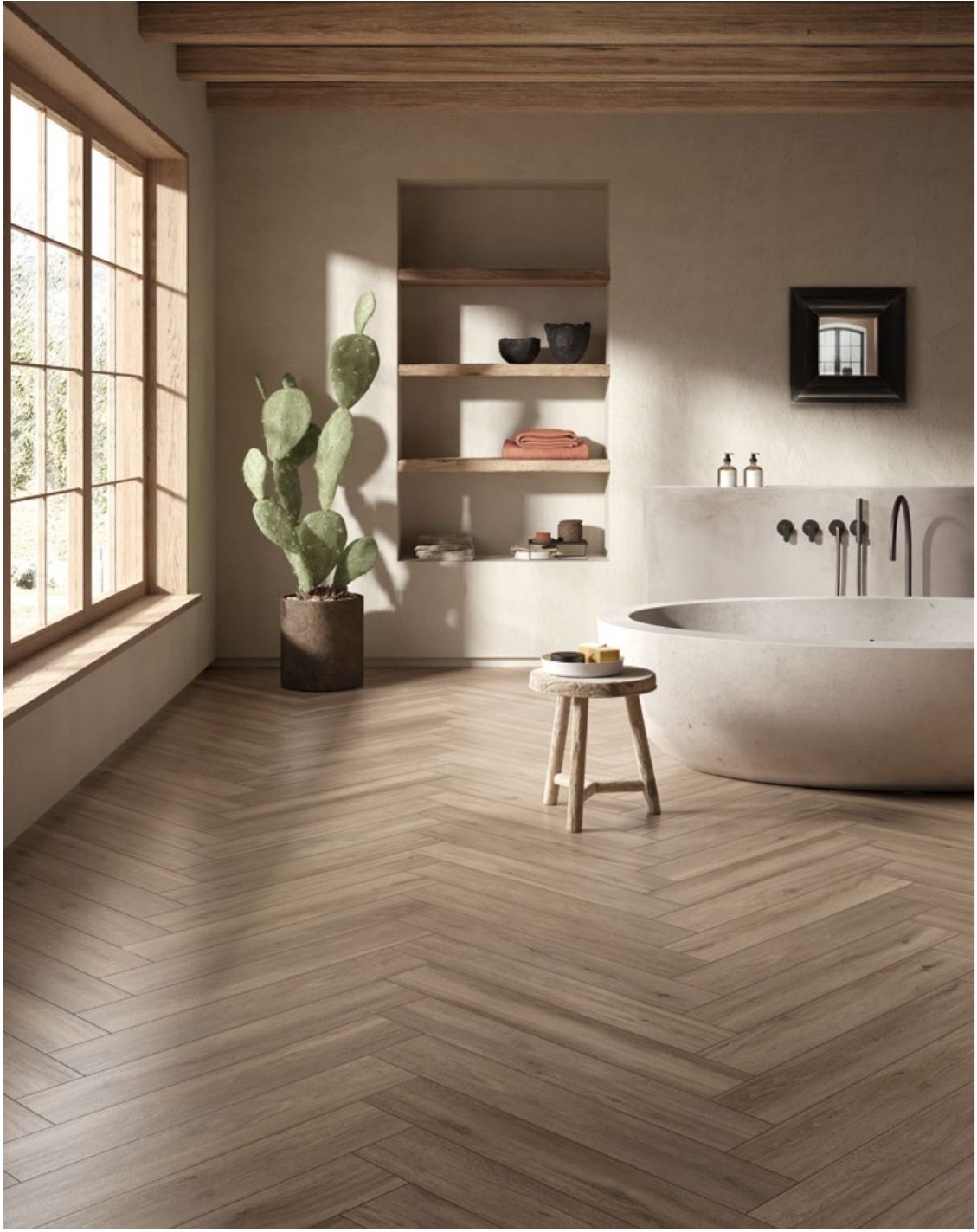
All the warmth of oak without the fear of water: wood-effect porcelain in the bathroom doesn’t swell, doesn’t stain and doesn’t mind the steam from the shower. Today’s graphics are almost indistinguishable from real wood, but the maintenance is that of a tile: a cloth and a neutral detergent. The best parquet for a bathroom, in short, is the one that isn’t wood.
Why real parquet in the bathroom is a gamble
Wood is a hygroscopic material: it absorbs moisture from the air and any water it meets. And in a bathroom it meets water every day. Steam from the shower, splashes from the basin, the wet mat left forgotten on the floor.
Over time the result is always the same: the planks swell, the edges lift, the joints open up. Parquets treated for damp environments do exist, that’s true. But they demand constant attention: drying every pool of water at once, renewing the oil or varnish periodically, always ventilating. A lapse costs you planks to replace.
Porcelain stoneware works the other way round: the water stays on the surface until you dry it. No swelling, no soaked-in stains, no treatments to remember.
Wood-effect porcelain in the bathroom or parquet: the honest comparison
Here’s the comparison point by point. We’ll admit one straight away: barefoot, real wood is warmer to the touch. Porcelain only levels the score if there’s underfloor heating beneath it — with which, incidentally, it gets along perfectly.
| Aspect | Parquet in the bathroom | Wood-effect porcelain |
|---|---|---|
| Water and steam | Swells if water pools | Doesn’t absorb (ISO 10545-3): no damage |
| Cosmetic and soap stains | Soak in if the finish is worn | Stay on the surface, gone with neutral detergent |
| Maintenance | Oil or varnish to renew | No treatment, just ordinary cleaning |
| Underfloor heating | Compatible but with limits: wood insulates | Conducts heat well, full performance |
| Warmth underfoot | Its strong point: warm by nature | Cooler; levels up with underfloor heating |
| Look over the years | Marks and changes with humidity | Stays like day one |
Translated: if you really use the bathroom — shower every day, kids, guests — porcelain takes every worry away. Real wood only makes sense in a lightly used guest bathroom, with an owner willing to care for it.
Then there’s the aesthetic question, which until a few years ago leaned in parquet’s favour. Not anymore: high-definition digital printing reproduces grain, knots and even the surface texture of wood, with dozens of different graphics per series. Once the floor is laid, you only spot the difference by touching it.
Cleaning and daily life: a cloth really is enough
On wood-effect porcelain the routine is this: vacuum or broom for dust, a cloth with water and neutral detergent for the rest. That’s it. No waxes, no dedicated products, no seasonal oiling.
Three tips worth the effort:
- Avoid detergents that are too aggressive or waxy: they won’t damage the tile, but they can leave films that dull the surface and trap dirt.
- Look after the grout lines: they’re the only point that can get dirty deep down. A quality grout matching the plank makes the floor more uniform and easier to keep.
- Dyes and cosmetics: even a hair dye comes off the surface of porcelain without a trace, as long as you don’t let it dry for days. On varnished wood, the same accident is often permanent.
Five pairings that really work
Wood-effect in the bathroom gives its best when it talks to a second material. Five tried-and-tested combinations, from the most classic to the boldest:
- Light plank + marble on the wall. Whitewashed oak on the floor and large marble-effect slabs in the shower area: it’s the spa look, bright and relaxing. In our catalogue the natural pair is Woodland with the Athena series.
- Medium oak + sage green. The wood warms, the matt shade cools. Just a sage wall above the tiling, or even only the coloured vanity unit. It works equally well with terracotta and sand.
- Dark plank + white and brass. Sharp contrast: walnut-tone floor, white fixtures, brushed brass fittings. Elegant and very photogenic. In small bathrooms, though, stay on medium tones: dark absorbs light.
- Grey Nordic wood + concrete-effect. A plank with grey veining, like North Wind, set against a concrete-effect wall: textured, contemporary, never cold.
- Herringbone + everything else neutral. Here the laying pattern is the star: plain walls and pared-back fixtures. Budget for 15% waste instead of 10%: we explain it in the herringbone laying guide.
Plank format: which size for a small bathroom
The classic plank measures around 20×120 cm. In a bathroom under 5-6 m² it might seem too much, but no: fewer grout lines means less visual grid, and the room looks larger. It’s the same principle we explain in the article on large formats in small spaces.
Two practical rules:
- Direction: lay the planks along the long side of the room, or towards the light source. The eye follows the lines and stretches the space.
- Waste: with straight laying budget 10% extra material; with diagonal or herringbone go up to 15%. On every one of our product pages you’ll find the m²⇄boxes calculator that does the maths for you, rounding up to the whole box.
One last detail from the technical sheet: many wood-effect series are shade-varied, meaning each plank has a different graphic, just like real wood. It’s not a defect: by mixing pieces from several boxes as you lay, you get a natural floor, with no obvious repetitions.
R10 in the bathroom: needed or not?
The R scale of the DIN 51130 standard measures slip resistance. For a home bathroom, in short:
- R9 is enough in most bathrooms: smoother surface, easier cleaning.
- R10 is the prudent choice if you have a flush shower floor, small children or elderly people in the house: more grip when the floor is wet.
- R11 in an indoor bathroom is almost always excessive: the textured surface traps dirt and complicates your cleaning.
You’ll find the R value on every one of our technical sheets. If you want to understand exactly how to read it, we’ve explained it room by room in the guide to the R9, R10 and R11 anti-slip classes.
Where to begin: a sample, then the project
Wood-effect porcelain is judged in person: the veining, the texture, the colour in your bathroom’s light. Photos, however faithful, aren’t enough.
The most sensible path is in three moves: browse the wood-effect porcelain category and pick two or three candidate planks; order the samples — 5 € each, refunded on your first order — and lay them in the bathroom for a few days, in natural and artificial light; then measure the room and let the m²⇄boxes calculator do the sums. The wood that doesn’t fear water starts here.