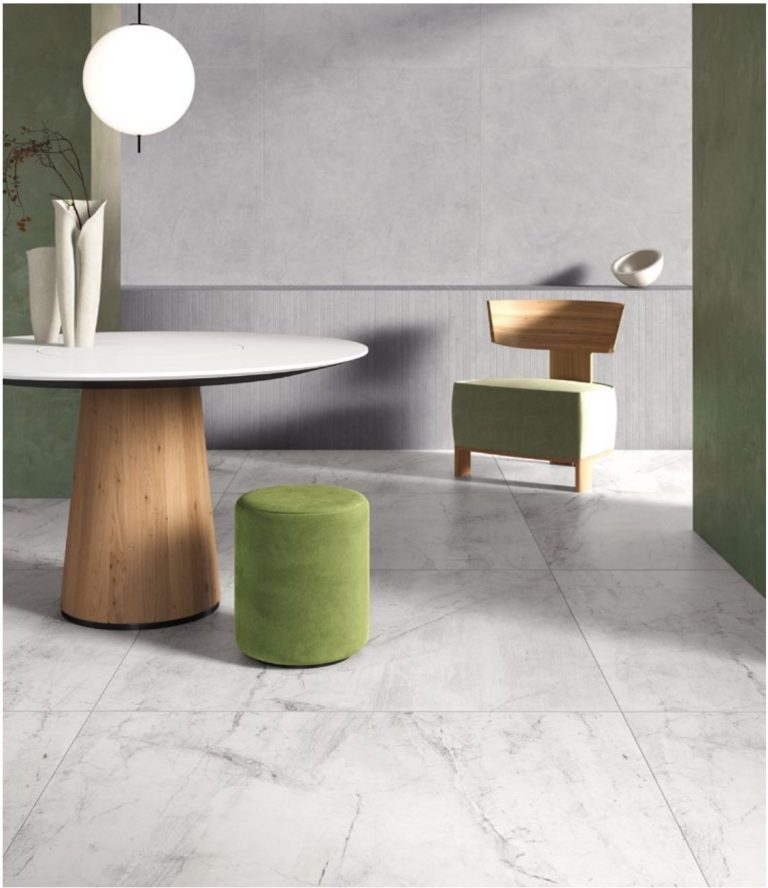
Lecce stone (pietra leccese) is the golden calcarenite of Salento, in Italy’s deep south: beautiful and extremely soft, but so porous that as a floor it absorbs everything and demands constant treatments. Lecce-stone-effect porcelain reproduces its ivory-straw colour, fine grain and fossils with absorption below 0.5%: no stains, no sealers, and the structured version works on verandas and pool decks too. In our catalogue the collection is called, fittingly, La Leccese.
Anyone who has been to Salento recognises it at first glance: the honey-coloured stone of Lecce’s palazzi, of the masserie (the region’s fortified farmhouses), of Baroque portals crowded with angels and pomegranates. Lecce stone is one of the most distinctive materials in Italian architecture — and one of the least suited to being the floor of a real home. This article is for anyone who wants that colour and that light underfoot, without signing up for lifelong maintenance: the road is called porcelain, and we’ll walk it to the end, numbers included.
What Lecce stone is (and why it wins hearts)
The charm is threefold: the warm, sunny colour, which under Mediterranean light shifts from ivory to gold; the fine, even grain, without dramatic veining, giving quiet, tactile surfaces; and the fossils, tiny shells and fragments telling you this stone was once a seabed. It’s the floor that says “seaside house” without an anchor hanging on the wall.
The hidden side: what happens to Lecce stone as flooring
The same softness that makes it carvable is its curse in daily use. Lecce stone has extremely high porosity (it absorbs 15-30% water depending on the variety: a hundred times a porcelain tile) and low hardness. Translated into domestic life:
- Everything stains it: wine, oil, coffee, even hard water leave their mark. It needs water- and oil-repellent sealers renewed every 2-3 years, and even they don’t stop acids.
- It wears down: heels, chairs, sand under shoe soles carve out the walking routes within a few years.
- Outdoors it suffers: frost (rare but not impossible even in the south) and salt air crumble it; wet areas turn slippery and grow mould.
In historic palazzi all this is patina and nobility. In a modern home, with the centrifuge of children, dogs and drinks on the veranda, it’s an unpaid part-time job.
La Leccese in porcelain: what the collection reproduces
The La Leccese collection by Cavallino Ceramica was born exactly for this short-circuit: the graphics of the Salento calcarenite — ivory-almond ground, fine grain, scattered fossils with natural shade variation — on the body of a porcelain stoneware that doesn’t absorb and doesn’t wear. The distinctive traits to know:
- The softened edge. The tiles’ perimeter is slightly irregular, like a hand-worked slab: once grouted, the antiqued effect is that of a masseria floor, not an industrial tile.
- Roman opus in a mixed box. The mixed-module pattern of ancient courtyards, with the formats already combined in the box: the floor looks as if it “grew there”, without the puzzle of ordering four separate formats.
- A double soul, indoors and out. The natural finish for interiors and the structured one for outdoors allow the veranda-kitchen continuity that defines southern houses — the same floor indoors and out project is almost mandatory here.
On choosing within the wider stone-effect family (Lecce stone versus travertine, ceppo, slate and the others) we’ve written a dedicated guide: how to choose stone-effect porcelain.
Real versus porcelain: the table and the veranda sum
| Property | Natural Lecce stone | La Leccese porcelain |
|---|---|---|
| Water absorption | 15-30% | ≤ 0.5% (ISO 10545-3) |
| Stains (wine, oil, coffee) | penetrate the material | stay on the surface, wipe off with detergent |
| Treatments | sealer every 2-3 years | none, ever |
| Wear from foot traffic | hollows out along walking routes | surface stable for decades |
| Outdoors / pool deck | not recommended (salt, mould, slippery) | structured R11 version, frost-proof |
| Uniqueness of the material | absolute: no two slabs alike | multiple graphics, but finite |
| Indicative price installed | 90-140 €/m² | 55-70 €/m² (material + standard installation) |
The worked sum on an 18 m² veranda: natural Lecce stone = 18 m² + 10% wastage = 19.8 m² × 95 €/m² of material = 1,881 €, plus specialised installation (18 × 55 € = 990 €) and initial treatment (18 × 12 € = 216 €): 3,087 €, with the sealer to renew on schedule. La Leccese porcelain = 19.8 m² × 29.90 €/m² incl. VAT = 592.02 €, plus standard installation (18 × 32 € = 576 €): 1,168.02 €, and that’s the end of it. The difference — nearly 2,000 € — is the pergola over the veranda.
And the table’s last row deserves our usual honesty: real stone remains unbeatable in one thing, uniqueness. Every quarried slab is one of a kind; porcelain works with a deck of graphics that sooner or later repeat. If you’re restoring a historic palazzo in Lecce, use the stone of your own walls. For the home you live in every day — sand, dogs, rosé in summer — porcelain is the choice that doesn’t hand you a bill every two years.
Where it looks right (even far from Salento)
- Seaside houses and verandas, obviously: it’s its natural habitat, from the Mediterranean to any coast.
- B&Bs and holiday homes: a strong Mediterranean identity in photos (the kind that fills the booking calendar) and zero maintenance between one guest and the next.
- Tactile bathrooms and kitchens in the city: the warm ivory tone softens modern interiors without the obviousness of beige, and with a resistance to detergents you could never ask of a real limestone. Outdoors, the structured version handles terraces and frosts: porcelain’s frost resistance is explained in our piece on frost-proof tiles.
Where to start
- See the collection in the stone-effect porcelain category: La Leccese is there, with formats, finishes and prices per m² incl. VAT.
- Order a sample (5 €, refunded on your first order): the ivory-gold tone needs to be seen in your light — in northern light it reads warmer than you’d imagine.
- Decide the pattern: a single format laid staggered for a contemporary look, Roman opus in a mixed box for the masseria feel. Remember 12-15% wastage on mixed patterns.
If the project is an indoor-outdoor continuity or a pool deck, write to us before ordering: we’ll confirm the right finishes and anti-slip classes for each zone.