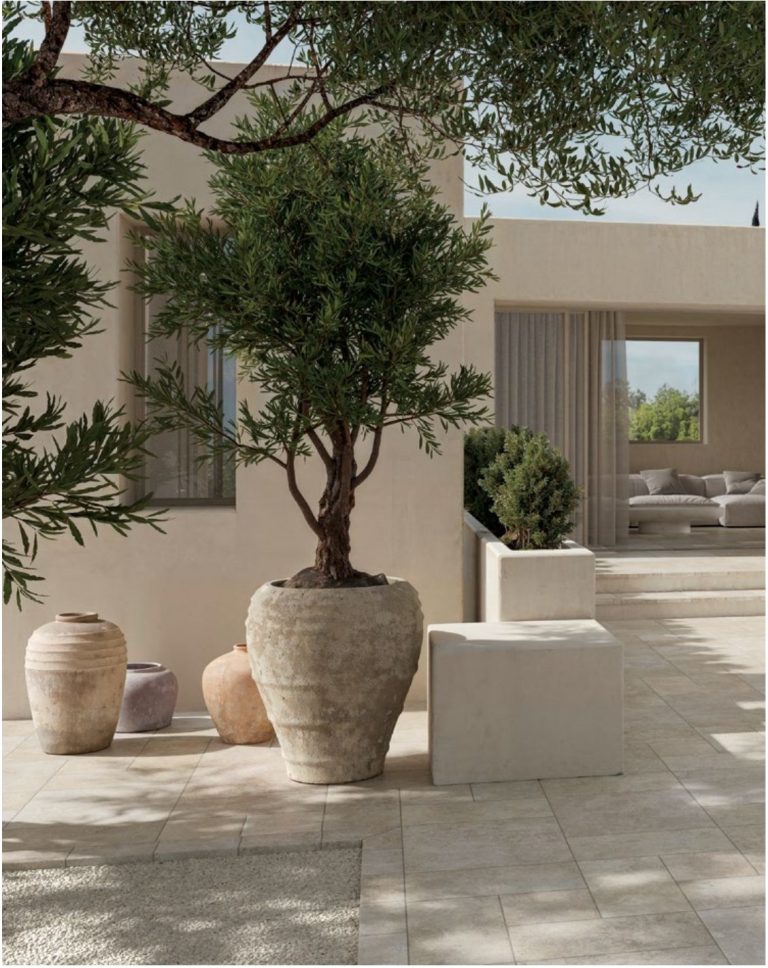
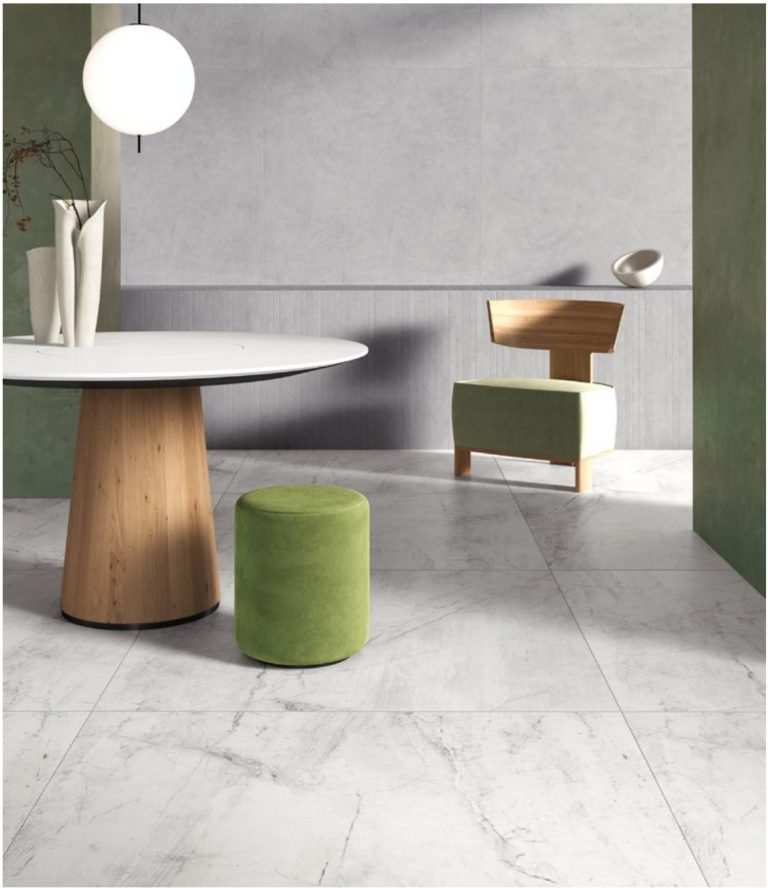
Stone-effect porcelain reproduces the natural stones most used in architecture — Ceppo di Gré, travertine, Lecce stone, slate, quartzite, Luserna stone and limestone — without their drawbacks: it doesn’t absorb, doesn’t stain, needs no treatment. To choose: start from the setting (indoor, outdoor or both), then the dominant colour of your home, and check shade variation and the number of graphics in the technical sheet.
“Stone effect” is the largest category in our catalogue and the most misunderstood. The reason is simple: there is no such thing as “the stone”. There are dozens of different stones — warm, cool, smooth, textured — and a stone-effect porcelain chosen by looking only at the cover photo often ends up in the wrong home: an Alpine quartzite in a Salento villa, a Roman travertine in a Nordic loft. In this guide we set things straight: the 7 most imitated stones, the character of each, and the three checks to make before you order.
Why porcelain beat natural stone (almost everywhere)
Real stone is stunning, and we say that as tile sellers. But at home it has three concrete problems: it absorbs (wine, oil and coffee stains sink into the material), it needs treatment (water- and oil-repellent sealers to renew every few years) and it costs, both per square metre and to lay, because thick, heavy slabs require specialised labour.
Stone-effect porcelain flips all three problems: it absorbs nothing, requires no treatment, and lays like any other tile. What you lose is the absolute uniqueness of nature — we’ll come back to that later, because it’s the one point where porcelain has to play its cards well.
The 7 most imitated stones: character, colours and where they work
Every natural stone has a precise personality. Recognising it saves you from the most common mistake: buying a generic “stone effect” and realising once the floor is laid that the grey was cool where you needed warm.
| Imitated stone | Character | Typical colours | Where it works |
|---|---|---|---|
| Ceppo di Gré | Lombard conglomerate with gravel inclusions: textured, urban, very current | Grey, anthracite, beige | Contemporary living rooms, outdoors, indoor-outdoor continuity |
| Travertine | Roman classic, soft horizontal veining | Beige, cream, walnut | Elegant bathrooms, Mediterranean outdoors, pool surrounds |
| Lecce stone | Warm, sunny, fine grain with fossils | Ivory, almond, straw | Seaside homes, verandas, Mediterranean style |
| Slate | Dark, schistose, surface in irregular planes | Black, dark grey, multicolour | Taverns, Alpine outdoors, dramatic settings |
| Quartzite | Alpine, crystalline, mineral reflections | Grey-green, silver, gold | Mountain homes, textured wall coverings |
| Luserna stone | Piedmontese, outdoor by vocation, subtle flaming | Grey-blue, mixed | Courtyards, ramps, outdoor stairs |
| Limestone | French limestone, uniform and understated | Sand, greige, light grey | Minimal interiors, large uniform surfaces |
In our Cavallino Ceramica catalogue these families have their own names: Ceppo di Gré for the Lombard conglomerate, La Leccese for the Salento stone, Dolomia Stone for the vein-cut dolomitic limestone, Colosseo Plus for warm tones over large surfaces and Limestone for the uniform, understated limestone. Each comes in several colours and formats, many also in a thickened outdoor version.
Indoor, outdoor or both: the first choice to make
Even before colour, decide where the tile will go. The three typical situations:
- Indoor only. You have maximum freedom: smooth natural finish, any format, even the most delicate graphics. Look for R9 or R10 for home floors.
- Outdoor only. You need a textured surface of at least R11 and certified frost resistance. Stone effect is in its natural habitat here: outside a “fake” stone convinces more than any wood effect.
- Indoor and outdoor in continuity. The same graphic exists in two finishes: natural for indoors, textured for outdoors. This is the project that visually enlarges home and terrace, and we’ve explained it step by step in the guide to the same flooring indoors and out.
Formats and laying patterns: from 60×60 to Roman opus
Natural stone has been laid in precise patterns for centuries, and porcelain has inherited them all. Three routes, in order of simplicity:
- Single format. 61×61 and 90×90 are the most balanced; the 61×122 stretches perspectives in living rooms. Lay it straight or offset by a third (never by 50% on long formats: the tile can show a slight central bow, and a half offset highlights it).
- Roman opus. The mixed-module scheme of ancient villas: three or four combined formats that break the grid and make the floor look like it “grew there”. Some of our collections, such as Dolomia Stone and La Leccese, offer it in a ready-to-assemble mixed box: no puzzle of separate orders.
- Wavy edge. The tile perimeter slightly irregular, like hand-worked stone: with a filled joint the aged effect is surprising. You’ll find it, for example, on La Leccese and Colosseo Plus.
A practical detail: mixed patterns generate more waste than straight laying. Allow for 12-15% instead of 10% when counting boxes.
Shade variation and graphics: how to spot a well-made stone effect
Here lies the only real risk of stone effect, and we’ll tell you plainly: natural stone never repeats itself, porcelain does. Every collection has a finite number of graphics (the different “faces”): if there are few, over a large surface the eye notices the twin tiles and the effect collapses.
Two checks in the technical sheet keep you safe:
- Shade variation V3 or V4. The V code measures how much tiles vary from one another: V3 is moderate variation, V4 strong, like real stone. If the code is unfamiliar, we’ve explained it in the guide to V1-V4 shade variation.
- Number of graphics. Well-made collections declare 20, 30 or more different faces. Below 10, think carefully on surfaces over 20 m².
A third check, this time at home: look at the sample in the light of your own space. A Ceppo grey that looks neutral in a photo can turn cool under a north-facing window.
Real stone or porcelain? The economics worked out
Let’s run the numbers on a 25 m² living room, comparing natural Ceppo di Gré slabs and a stone-effect porcelain from our catalogue at €29.90/m² VAT included.
The calculation in detail, item by item:
- Natural stone. Material: 25 m² + 10% waste = 27.5 m² × €110/m² = €3,025. Specialised laying: 25 m² × €70/m² = €1,750. Water- and oil-repellent treatment: 25 m² × €12/m² = €300. Total: €5,075, partly to be renewed every 3-5 years.
- Stone-effect porcelain. Material: 27.5 m² × €29.90/m² = €822.25. Standard laying: 25 m² × €30/m² = €750. Treatments: none. Total: €1,572.25, once and for all.
The per-square-metre prices you see with us are always VAT included, so the sum you make on the site is the sum you pay.
Where to start
Three moves, in the right order:
- Narrow down to one stone family. Use the table above: your home’s climate, light and style lead you almost on their own to 2-3 candidates in the stone effect category.
- Order the samples. They cost €5 and we refund them on your first order: seeing them in the real light of your home is worth more than a hundred photos. How it works is on the samples at home in 24-48h page.
- Check the technical sheet. Shade variation V3-V4, a slip class suited to the setting, an outdoor version if you need indoor-outdoor continuity.
If you have a doubt about a specific stone — “does this Lecce stone go well with my green window frames?” — write to us: we’ll look at the project together before you order.