For an indoor garage you need 9-10 mm porcelain solid-bedded onto a sound screed: what carries the car is not the thickness of the tile but the bed of adhesive with no voids underneath it. On the datasheet ask for water absorption ≤ 0.5% (ISO 10545-3), R10 in a dry garage and R11 where water gets in, PEI 4-5 if it is glazed, and a joint of at least 3 mm — epoxy if you can, because the grout is the part that fears oil. The 20 mm is only for outside: ramp, driveway, dry-laid paving.
The garage floor is the last one you decide on and the first one that fails. Bare concrete dusts for years, drinks every drop of oil and never comes clean again; interlocking PVC tiles are cheap and deform where a wheel turns on the spot. Porcelain is the permanent answer, but only if you choose and lay it properly: there is a vehicle weighing a tonne and a half driving onto it every day, and the parameters that matter here are not the living-room ones.
Garage floor tiles: why porcelain beats interlocking PVC
Search for garage floor tiles and you mostly find the same thing: interlocking PVC squares, 30×30, laid in an afternoon with no adhesive. They are an honest product, and in two cases they are the right call: if the garage is rented or temporary anyway, and if the substrate is so poor that putting it right would cost more than the floor itself. In every other case the maths flips within a few seasons.
PVC’s weak point isn’t the car driving over it: it’s the car standing still. Under a wheel that stays in the same spot for days the polymer slowly yields and keeps the imprint, and turning the steering wheel while parked pulls directly on the interlocking joint. Add summer heat, which softens the tile, and the car’s own fluids: diesel and engine oil mark PVC, while they wash off porcelain.
- Parked car: PVC keeps the wheel imprint, porcelain doesn’t — it’s a ceramic material and doesn’t deform.
- Oil, diesel, brake fluid: porcelain with ≤ 0.5% absorption doesn’t take them up; PVC stains and softens.
- Cleaning: porcelain washes like any floor in the house; dirt and damp collect under PVC’s interlocking joints.
- Lifespan: PVC is a floor you replace at some point, porcelain lasts as long as the building.
- Laying and cost: PVC wins here — you lay it yourself, dry, and you can lift it again. Porcelain needs a sound screed and full adhesive coverage, which is why it costs more up front.
The real question isn’t which material is better in the abstract: it’s how long that floor has to last. If the garage is yours and you park in it every day, porcelain is the choice you don’t make twice. If you need something reversible over a substrate you’d rather not touch, PVC makes sense — and the rest of this guide isn’t for you.
It isn’t the tile that carries the car: it’s what sits underneath
Let’s do the real sum, because it dismantles half the fear. The pressure a car puts on the ground is, in practice, the pressure of its tyres: about 2.2 bar, that is 0.22 N/mm². The figure holds from the other direction too: a 1,300 kg hatchback puts roughly 325 kg on each wheel over a contact patch of some 15 by 10 centimetres, so around 0.2 N/mm². A two-tonne SUV reaches 0.3.
The comparison works as an order of magnitude, not as a structural calculation: tyre pressure and the flexural stress in a tile are two different quantities. But the margin is that big. Which brings us to the point nobody makes: those 35 N/mm² apply to a tile that is fully supported. If an air pocket is left underneath — adhesive dabbed in spots, wrong trowel, an out-of-level screed — the tile at that spot works like a cantilever, and that is where the wheel cracks it. When a garage floor cracks, it is almost never the tile’s fault: it is the fault of a void underneath. Everything else in this article follows from that.
Thickness: 9-10 mm inside the garage, 20 mm only for ramp and driveway
This is the most expensive misunderstanding around, and it circulates on serious sites too. “Vehicular = 20 mm” is not true: it depends on how you lay it.
- Indoor garage, bonded onto a screed: 9-10 mm is the correct thickness. The tile does not work on its own, it works together with the screed that supports it across its whole surface. Going to 20 mm here adds no safety: it adds weight, cost and 11 mm of level that you then have to reconcile with the threshold and the up-and-over door.
- Ramp, driveway, outdoor parking space: this is where 20 mm porcelain belongs, and it comes with a caveat catalogues print in small type — laid dry on gravel, grass or sand the 20 mm is pedestrian, not vehicular. To carry a car it has to be bonded with full coverage onto a reinforced screed, exactly like the 9 mm. Dry laying is covered case by case in the guide to 20 mm porcelain outdoors.
We won’t go into the screed itself, because that is the contractor’s remit; what it has to deliver, though, is clear — no through cracks, flatness within 2 mm under a 2 m straightedge, load capacity matched to the vehicle, and drying complete. If the old screed sounds hollow under the tap of a hammer, that area is rebuilt first, not drowned in adhesive.
R10 or R11: it depends where the water gets in
In a garage the danger isn’t the car, it’s you walking. Wet tyres carry water in and deposit it exactly where you put your feet as you get out. Slip resistance is measured to DIN 51130 on the inclined ramp (R9 up to 10°, R10 up to 19°, R11 up to 27°) and the choice is made zone by zone:
- Closed, dry, level garage: R10 is enough and cleans far better.
- Garage you drive into with a wet car, wash bay, pedestrian entrance: R11, structured surface.
- Sloping ramp, indoors or out: R11 as a minimum, no argument. Above 15% gradient, discuss R12 or a dedicated anti-slip finish with your installer.
One practical advantage of a garage: here R11 has none of the drawbacks it has indoors. Nobody walks barefoot in a garage, and a structured surface can be jet-washed. If you want the full picture of the classes, it is in the guide to R9, R10 and R11.
Abrasion and staining: PEI, oil, road salt and tyre marks
A garage is aggressive in a very particular way: little water, a lot of greasy dirt, and grit dragged in by the wheels acting as sandpaper. In northern Europe add a fourth: from November to March the car brings in a slush of de-icing salt that sits in the joints and dries there. Porcelain doesn’t care; cementitious grout does. Three parameters to read on the datasheet:
- Abrasion. If the tile is glazed, look for PEI 4 or 5 (ISO 10545-7): those are the heavy-traffic classes. If it is unglazed full-body porcelain, PEI does not apply at all — you look at deep abrasion to ISO 10545-6, which for porcelain stays within 175 mm³. That is why full-body is technically the most relaxed choice for a garage.
- Stains and chemicals. With absorption below 0.5% (ISO 10545-3), engine oil, brake fluid and antifreeze stay on top of the tile: they do not penetrate. On the datasheet look for stain resistance class 5 (ISO 10545-14) and chemical resistance class A to household products (ISO 10545-13).
- Black tyre marks. Here is the limitation we happily admit, because nobody writes it down: on pale, matt surfaces warm rubber leaves black streaks where the wheel turns on the spot. It is not an absorbed stain, an alkaline degreaser removes it, but it comes back. The fix happens at selection stage: avoid very pale tiles in the manoeuvring zone and prefer mid-dark or patterned tones.
The grout is the weak point (and the laying is all the rest)
The tile does not absorb. Cementitious grout does: that is where the drip from the engine becomes a permanent halo, and that is where a garage floor ages badly. The rules we pass on to anyone ordering for a garage:
- Joint of at least 3 mm, even on rectified tiles (4-5 mm on the ramp). Under load the joint distributes stress between tiles: the minimum-joint living-room approach is, here, a structural error.
- Grout: cementitious CG2 as a minimum, epoxy RG if you can (classification EN 13888). Epoxy costs more and is harder to work, but it is impermeable to oil, petrol, battery acid and salt. On a 15 m² garage the difference is in the order of a hundred euros: it is the best money spent on the whole job.
- C2 deformable adhesive, back-buttered, full coverage. Classification EN 12004/ISO 13007: C2 is the improved cementitious class, S1 adds deformability. Every national installation code says the same thing for external and heavy-traffic floors — BS 5385-3 and -4 in the UK and Ireland, DIN 18157 with the buttering-floating method in Germany and Austria, UNI 11493-1 in Italy: adhesive on the screed and on the back of the tile, until the bed is full. No voids: see above for why.
- Movement joints respected. A free perimeter joint along every wall, intermediate joints over those in the screed and every 20-25 m² inside (closer outside, every 9-12 m²). A floor that cannot expand will tent.
- A 1-1.5% fall towards the drain or the door: the water running off the car has to go somewhere.
- Medium format, not giant. A 61×61 or a 30×61 is far easier to bed at full coverage than a 120×120. In a garage, laying certainty is worth more than the slab effect.
One last detail from experienced tilers: when you use a jack or axle stands, put a board of wood underneath. The car’s load spread over four tyres is nothing; the same load concentrated on a plate a few square centimetres wide is the one realistic way to chip porcelain.
What to ask for on the datasheet (indoor garage and outdoor ramp)
| Requirement | Indoor garage | Outdoor ramp / driveway | Standard |
|---|---|---|---|
| Thickness | 9-10 mm bonded to a screed | 20 mm, bonded to a reinforced screed if vehicular | — |
| Water absorption | ≤ 0.5% (true porcelain stoneware) | ISO 10545-3 | |
| Modulus of rupture | ≥ 35 N/mm² | ISO 10545-4 | |
| Slip resistance | R10 (R11 if water gets in) | R11 minimum | DIN 51130 |
| Abrasion | PEI 4-5 if glazed · deep abrasion ≤ 175 mm³ if full-body | ISO 10545-7 / -6 | |
| Stains and chemicals | class 5 to stains, class A to household products | ISO 10545-14 / -13 | |
| Frost resistance | useful in unheated garages | mandatory | ISO 10545-12 |
| Grout | CG2 minimum, epoxy RG better | EN 13888 | |
One clarification on frost, because we get asked often: a closed, dry garage rarely truly freezes, because for frost to break something it needs water inside the material. With porcelain the question doesn’t really arise — at that absorption it is frost-proof by constitution — but if the garage is open, below ground or takes snow off the wheels, check the certification is there. We explained the mechanism in the guide to frost-proof tiles.
Where to start
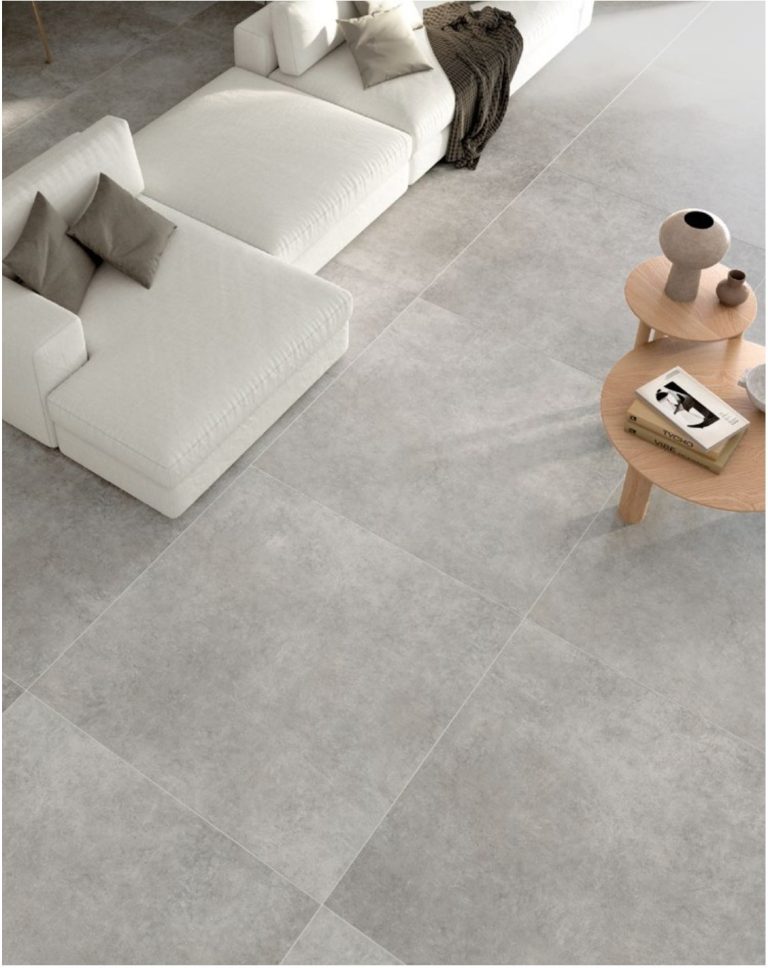
Looks are the last parameter in a garage — but since the price is the same, you may as well choose well: concrete effect is the natural family for this room (268 references in the catalogue), mid greys that hide dust and marks, and the same graphic exists in a structured version for the ramp and a smooth one for the room next door.
The sum worked through for a single 15 m² garage, with a real reference from our catalogue — Caementum Griseo 61×61 cm Outdoor, R11, 9 mm, rectified, at 30.00 €/m² VAT included:
- Material: 15 m² + 10% wastage = 16.5 m² → ordered in whole boxes of 1.49 m², so 12 boxes = 17.88 m² × 30.00 € = 536.40 € (348 kg: pallet delivery to the kerbside).
- Installation: 15 m² × 32 €/m² back-buttered ≈ 480 €. Indicative figure: tiling rates vary a great deal from one country and region to the next, so treat it as a benchmark rather than a quote.
- Epoxy grout: around 10 €/m² between material and labour = 150 €.
- Indicative total: about 1,170 €, once, for a floor that does not dust, cleans with a degreaser and lasts as long as the house.
The catalogue price is the same across all five language versions of the site and always shown VAT included; the exact amount for a delivery outside Italy is confirmed at checkout.
Three moves, in this order: 1) measure the garage and check the state of the screed with your contractor; 2) pick the R class zone by zone (garage, entrance, ramp) and order samples at 5 €, refunded on your first order; 3) hand the tiler the rules in this article — full coverage, 3 mm joint, movement joints, fall.
If your project includes a garage, an outdoor ramp and a utility room together, write to us before ordering: we’ll tell you which references share the same graphic in different finishes, so the step from inside to outside doesn’t show.