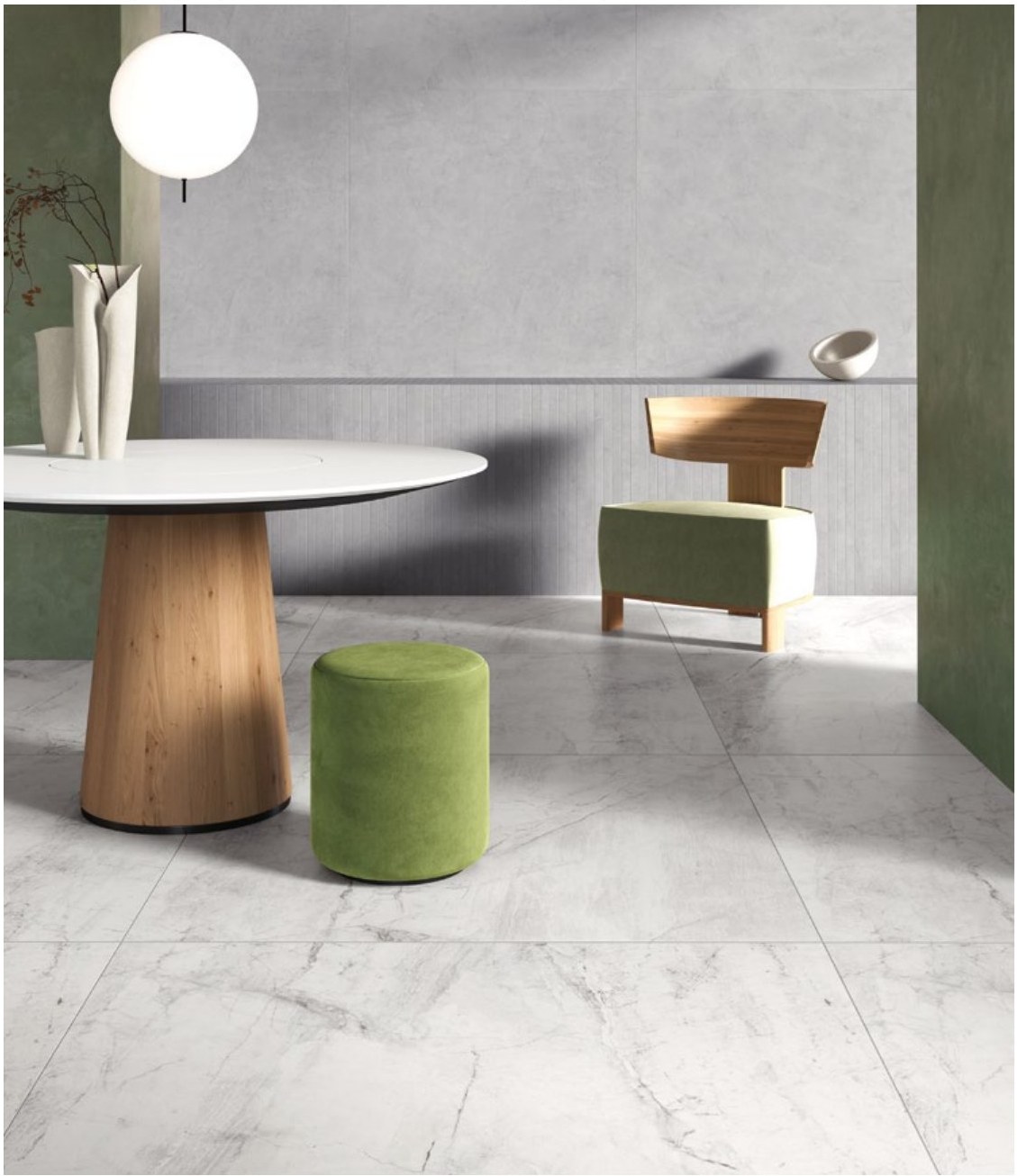
Marble-effect tiles are the most sensible way to bring marble into a bathroom: porcelain doesn’t absorb cosmetics or limescale removers (natural marble’s true enemies), needs no treatment and costs a third as much. For a designer result: large formats to reduce grout lines, a matt finish on the floor and in the shower, gloss only on walls, and a collection with many different graphic faces so the veining never repeats.
The marble bathroom is an archetype: from Roman baths to hotel suites, it’s the material that says “luxury” without needing a caption. The problem is that real marble, precisely in the bathroom, is in the worst possible place. And the good news is that marble-effect porcelain is no longer the “fallback”: today it’s the choice made even by designers who could afford the real thing. Let’s see why, and how to choose well.
Why real marble suffers in the bathroom (of all places)
Marble is calcium carbonate: chemically, the same substance as the limescale you fight on your taps. Hence its three weak points, all concentrated in the bathroom:
- Acids corrode it. Limescale remover, vinegar, WC cleaners: one forgotten drop dulls the surface permanently (“etching”). In a room where limescale remover is a staple, it’s an impossible cohabitation.
- It absorbs and stains. Cosmetics, bath oils, hair dye: they penetrate the porous stone and stay. Impregnating sealers help but need renewing, and they don’t stop acids.
- It costs three times over: the material, the specialised installation of heavy slabs, and the maintenance over the years.
Marble-effect porcelain stoneware wipes out all three: absorption below 0.5%, a surface untouched by household cleaners, standard tile installation. Today’s high-definition digital printing reproduces veining, clouding and translucency at a level that, once the floor is laid, fools even trained eyes.
What you lose versus real marble (we’ll tell you ourselves)
The honest point of the article: porcelain is not marble, and in two situations it shows. The first is graphic repetition: every collection has a finite number of different faces, and in a large bathroom two twin tiles side by side break the illusion. There is a defence: choose collections with many faces and ask your tiler to mix the boxes and keep twins apart. The second is the deep lustre of genuine polished marble, that millimetric translucency which glossy glaze imitates well but doesn’t fully replicate — noticeable up close, in raking light, to those who know what to look for.
For everything else — colour, veining, overall impact — it’s an even match. And on stains, maintenance and price, porcelain wins without breaking a sweat.
Which marble to choose: whites, warm stones or dark marbles
“Marble effect” is not a single colour. The three main families, and what they do to a bathroom:
- Veined whites (calacatta, statuario). Milk-white ground, grey or gold veining. They brighten, enlarge, go with everything: the safe choice for small or windowless bathrooms. Our Athena collection works precisely in this register.
- Warm marbles (cream, travertine, honey onyx). Ivory and sand tones, soft veining: an elegant yet welcoming bathroom, perfect with wood and brass.
- Dark marbles (marquina black, alpine green). Dramatic, to be dosed carefully: one wall, the basin top, the shower niche. On all six faces of a small bathroom they become a cave.
Pairings that always work: light marble + wood-effect porcelain on the floor (the “spa” bathroom), marble + matt black taps (contemporary), dark marble + brass (1930s hotel).
Formats and grout lines: luxury lives in the joints you don’t see
Suite marble comes in slabs: the sense of luxury also comes from the absence of a grid. In porcelain, the practical translation is: the largest possible format, the thinnest possible joint (2 mm with rectified tiles), grout colour matched to the tile’s ground.
| Bathroom zone | Recommended format | Finish | Note |
|---|---|---|---|
| Walls (dry zones) | 60×120 laid vertically | gloss or matt | vertical laying raises the ceiling |
| Shower wall | 60×120 / 120×120 | gloss allowed | fewer joints = less limescale to clean |
| Bathroom floor | 60×60 / 60×120 | matt (natural), R9-R10 | never polished gloss on the floor |
| Tiled shower tray | mosaic or small cuts | structured | you need falls and wet-foot grip |
If the bathroom is small, don’t fear large formats: counter-intuitively, fewer grout lines make the room feel bigger. We explained it with diagrams in our guide to large formats in small rooms.
Gloss or matt: the water rule
The question always comes, and the rule is simple: gloss goes where water runs vertically, matt goes where you walk. On walls, a glossy finish heightens the veining and bounces the light — that’s where the marble effect shines. On floors, gloss is slippery when wet and shows smears and limescale drops every single day: the natural matt finish holds the colour, forgives limescale and provides the right grip (look for R9-R10 on the data sheet, as explained in our guide to anti-slip classes).
The sum: real marble bathroom vs marble effect
A typical bathroom to renovate: 5 m² of floor and 18 m² of wall covering, 23 m² in total. With 10% wastage you need 25.3 m² of material.
- Natural marble (commercial calacatta). Material: 25.3 m² × 120 €/m² = 3,036 €. Specialised installation: 23 m² × 60 €/m² = 1,380 €. Impregnating treatment: 23 m² × 12 €/m² = 276 €. Total: 4,692 € — and the maintenance starts again every 2-3 years.
- Marble-effect porcelain. Material: 25.3 m² × 29.90 €/m² incl. VAT = 756.47 €. Standard wall installation: 23 m² × 40 €/m² = 920 €. Treatments: zero. Total: 1,676.47 €.
Three thousand euros of difference on a single bathroom: roughly the cost of the wall-hung sanitaryware, the good taps and the rain shower head you’d been postponing. That’s the point of the title: luxury isn’t in the material, it’s in the effect — and today the effect costs what porcelain costs.
Where to start
- Choose the marble family (veined white, warm, dark) based on your bathroom’s light and size: it’s the decision that steers all the others.
- Order samples of the candidate collection — 5 €, refunded on your first order: the veining must be seen under your bathroom’s light, which is not your monitor’s.
- Lock in formats and finishes zone by zone with the table above, and check R class and shade variation on the data sheet before ordering.
All the marbles in the catalogue are in the marble-effect porcelain category, priced per m² incl. VAT with the box calculator on every page. For a pairing doubt, write to us: two photos of your bathroom are enough for an answer on your specific case.